Introduction
This Highway Code applies to England, Scotland and Wales. The Highway Code is essential reading for everyone.
The aim of The Highway Code is to promote safety on the road, whilst also supporting a healthy, sustainable and efficient transport system.
Wording of The Highway Code
Many of the rules in the Code are legal requirements, and if you disobey these rules you are committing a criminal offence. You may be fined, given penalty points on your licence or be disqualified from driving. In the most serious cases you may be sent to prison. Such rules are identified by the use of the words ‘MUST/MUST NOT’. In addition, the rule includes an abbreviated reference to the legislation which creates the offence. See an explanation of the abbreviations.
Although failure to comply with the other rules of the Code will not, in itself, cause a person to be prosecuted, The Highway Code may be used in evidence in any court proceedings under the Traffic Acts (see The road user and the law) to establish liability. This includes rules which use advisory wording such as ‘should/should not’ or ‘do/do not’.
Knowing and applying the rules
Knowing and applying the rules contained in The Highway Code could significantly reduce road casualties. Cutting the number of deaths and injuries that occur on our roads every day is a responsibility we all share. The Highway Code can help us discharge that responsibility. Further information on driving/riding techniques can be found in ‘The Official DVSA Guide to Driving - the essential skills’ and ‘The Official DVSA Guide to Riding - the essential skills’.
Self-driving vehicles
By ‘self-driving vehicles’, we mean those listed as automated vehicles by the Secretary of State for Transport under the Automated and Electric Vehicles Act 2018.
To check if your vehicle is self-driving, visit Self-driving vehicles listed for use in Great Britain.
These vehicles are capable of safely driving themselves when the self-driving function is correctly turned on and the driver follows the manufacturer’s instructions. While the vehicle is driving itself, you do not need to monitor it.
Self-driving vehicles differ from vehicles that are fitted only with assisted driving features (like cruise control and lane-keeping assistance). Assisted driving features can do some of the driving, but the driver still needs to be responsible for driving at all times. If you are driving a vehicle using only its assisted driving features, Rule 150 applies.
A self-driving vehicle’s ability to drive itself may be limited to certain situations or parts of a journey. Things like the type of road, time of day, weather, location and speed may affect this. You should follow the manufacturer’s instructions about when and how to use the self-driving function safely.
While a self-driving vehicle is driving itself in a valid situation, you are not responsible for how it drives. You may turn your attention away from the road and you may also view content through the vehicle’s built-in infotainment apparatus, if available.
But you MUST still follow all relevant laws
- You MUST be fit to drive (for example, you must be within the drink-drive legal limits and not be under the influence of drugs). See Rules 90 to 96.
- The vehicle MUST be road legal (for example, it must have an MOT certificate, if applicable, and it must be taxed and insured). The vehicle must be roadworthy (see Rules 89 and 97; and Motor vehicle documentation and learner driver requirements and Vehicle maintenance, safety and security). You will also still be responsible for your passengers and anything else you are carrying (see Rules 98 to 102).
- You MUST NOT do anything illegal – like using a handheld mobile phone, or similar hand-held device. There are exceptions to this, which are set out in Rule 149.
If a self-driving vehicle needs to hand control back to the driver, it will give you enough warning to do this safely. You MUST always be able and ready to take control, and do it when the vehicle prompts you. For example, you should stay in the driving seat and stay awake. When you have taken back control or turned off the self-driving function, you are responsible for all aspects of driving.
Hierarchy of Road Users
The ‘hierarchy of road users’ is a concept that places those road users most at risk in the event of a collision at the top of the hierarchy. The hierarchy does not remove the need for everyone to behave responsibly. The road users most likely to be injured in the event of a collision are pedestrians, cyclists, horse riders and motorcyclists, with children, older adults and disabled people being more at risk. The following H rules clarify this concept.
Rule H1
It is important that ALL road users are aware of The Highway Code, are considerate to other road users and understand their responsibility for the safety of others.
Everyone suffers when road collisions occur, whether they are physically injured or not. But those in charge of vehicles that can cause the greatest harm in the event of a collision bear the greatest responsibility to take care and reduce the danger they pose to others. This principle applies most strongly to drivers of large goods and passenger vehicles, vans/minibuses, cars/taxis and motorcycles.
Cyclists, horse riders and drivers of horse drawn vehicles likewise have a responsibility to reduce danger to pedestrians.
None of this detracts from the responsibility of ALL road users, including pedestrians, cyclists and horse riders, to have regard for their own and other road users’ safety.
Always remember that the people you encounter may have impaired sight, hearing or mobility and that this may not be obvious.
Rule H2 - Rule for drivers, motorcyclists, horse drawn vehicles, horse riders and cyclists
At a junction you should give way to pedestrians crossing or waiting to cross a road into which or from which you are turning.
You MUST give way to pedestrians on a zebra crossing, and to pedestrians and cyclists on a parallel crossing (see Rule 195).
Pedestrians have priority when on a zebra crossing, on a parallel crossing or at light controlled crossings when they have a green signal.
You should give way to pedestrians waiting to cross a zebra crossing, and to pedestrians and cyclists waiting to cross a parallel crossing.
Horse riders should also give way to pedestrians on a zebra crossing, and to pedestrians and cyclists on a parallel crossing.
Cyclists should give way to pedestrians on shared use cycle tracks and to horse riders on bridleways.
Only pedestrians may use the pavement. Pedestrians include wheelchair and mobility scooter users.
Pedestrians may use any part of the road and use cycle tracks as well as the pavement, unless there are signs prohibiting pedestrians.
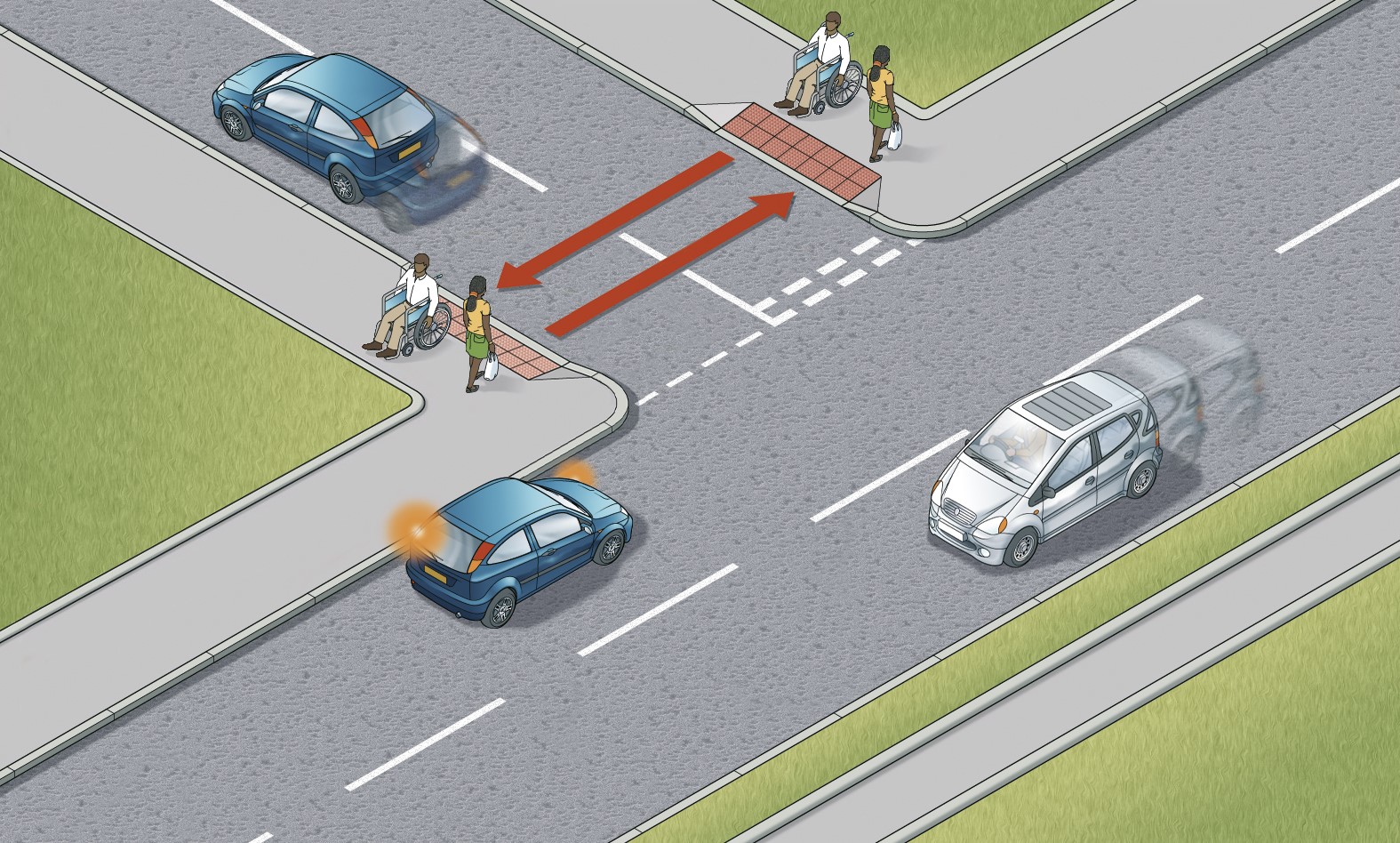
Rule H2: Wait for the pedestrian to cross the junction before turning. This applies if you are turning right or left into the junction.
Rule H3 - Rule for drivers and motorcyclists
You should not cut across cyclists, horse riders or horse drawn vehicles going ahead when you are turning into or out of a junction or changing direction or lane, just as you would not turn across the path of another motor vehicle. This applies whether they are using a cycle lane, a cycle track, or riding ahead on the road and you should give way to them.
Do not turn at a junction if to do so would cause the cyclist, horse rider or horse drawn vehicle going straight ahead to stop or swerve.
You should stop and wait for a safe gap in the flow of cyclists if necessary. This includes when cyclists are:
- approaching, passing or moving off from a junction
- moving past or waiting alongside stationary or slow-moving traffic
- travelling around a roundabout
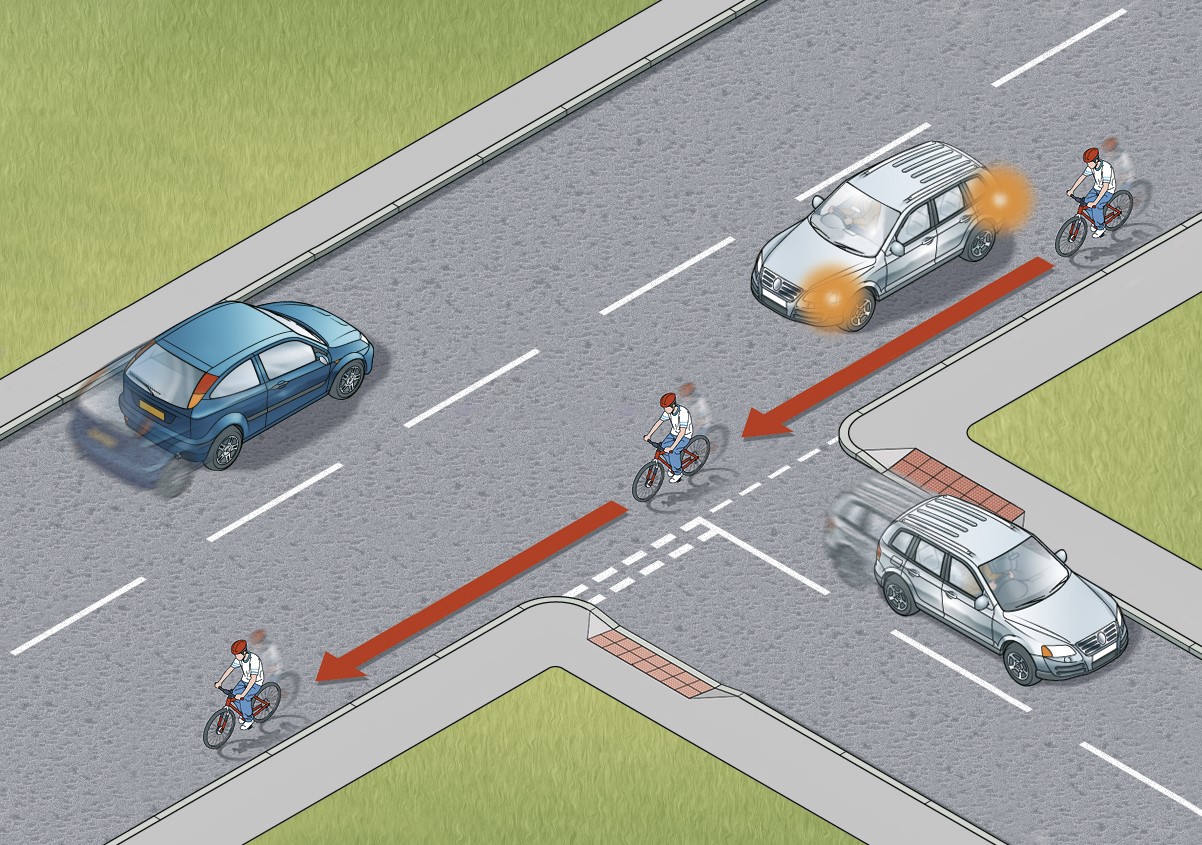
Rule H3: Wait for the cyclist to pass the junction before turning. This also applies if there is a cycle lane or cycle track and if you are turning right or left into the junction.